
REX: So… I failed Day 3 of Week 3.
Not “oh it was a bit hard.”
I mean failed failed.
The app said “Run 3 minutes.”
My body heard “Panic for 90 seconds, die for 60, then fake‑jog for the last 30 so the watch doesn’t judge you.”
When the cooldown ended, I stared at my screen and realized:
If I’m honest, I have to redo the whole week.
And suddenly it wasn’t just “Week 3” I was repeating. In my head it was:
“You’re a fraud.”
“Real runners don’t repeat weeks.”
“You can’t even handle a beginner plan, what were you thinking?”
I actually caught myself hovering over the “delete app” button, because that felt easier than pressing “Week 3 – Day 1” again.
FLY: Good. Now you’re finally training like an adult athlete instead of a movie montage.
Repeating a week is not evidence that you’re broken.
It’s evidence that your biology is sending useful data.
In high‑performance sport, repeating a load block is a standard protocol: when tissue stress is high or adaptation is incomplete, you don’t pile more on — you consolidate.
So let’s stop treating “repeat” as a confession and start treating it as exactly what it is: a calculated, data‑driven decision to let your bones, tendons, and cardiovascular system actually catch up.
The Biology of Adaptation: What Happens When You Repeat a Week
FLY: Your feelings are faster than your tissues.
Muscles adapt relatively quickly. You can notice strength or endurance improvements in a couple of weeks, because muscle fibers respond rapidly to training stress: more mitochondria, more aerobic enzymes, better neural activation.
But the structures that carry running stress — tendons, ligaments, joint cartilage, and bone — move on a much slower timetable.
How long different tissues take to adapt
Muscles: days to weeks — they get stronger and more efficient relatively fast.
Tendons & ligaments: weeks to months — collagen turnover and increased stiffness take longer; push too fast and they complain.
Bone: months — loading stimulates bone remodeling and density increases, but too much, too soon creates stress‑fracture risk before density has time to rise.
Running multiplies your body weight into roughly 2–3.6 times your mass at each foot strike, according to gait and force‑plate studies compiled by Perry & Burnfield.
That’s great for building stronger tissue if the increase is gradual; it’s a problem if you’re stacking load faster than bone and collagen can reinforce themselves.
Repeating a week means you’re giving those slower‑adapting tissues another 7–10 days under the same stress instead of ramping it up again. From a biological standpoint, that’s not a step backward. That’s exactly how you lock in adaptation.
Our main guide What Is Couch to 5K and Does It Actually Work? explains how traditional C25K schedules were built for “average” beginners — not for your exact training history, injury background, sleep, stress, or bodyweight.
And when What to Do When Couch to 5K Feels Too Hard kicks in, the first line of defense isn’t “toughen up.” It’s “adjust the dose.” Repeating a week is the cleanest dose adjustment possible.
The AthliFly "Should I Repeat?" Decision Matrix
You don’t need vibes. You need rules.
Use this matrix to decide whether to move on or repeat — no self‑insults required.
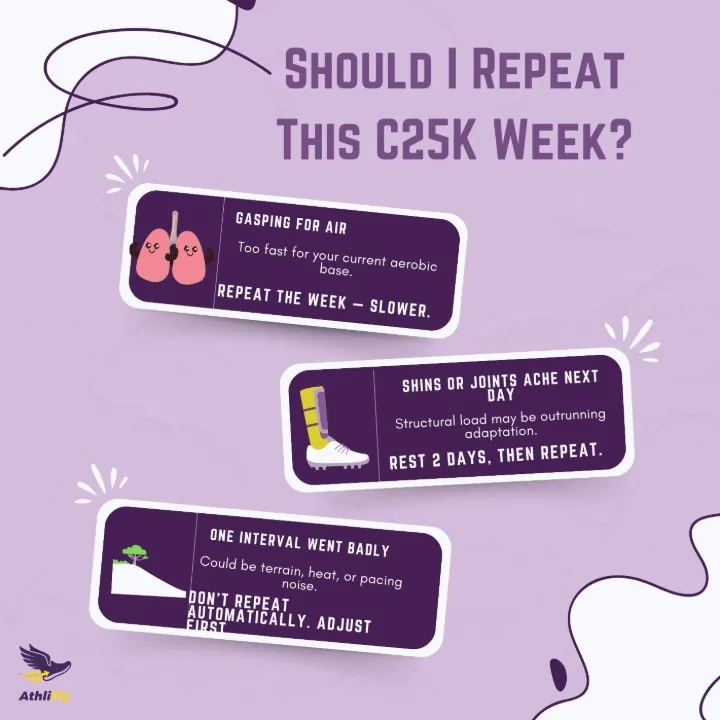
REX: So sometimes the right move is “don’t repeat, just slow down,” and sometimes it’s “rest, then repeat,” and sometimes it’s “you’re fine, move on”?
FLY: Exactly. You’re running a body, not an app. The matrix helps you choose based on biology, not guilt.
How to Execute a Repeat Week Like a Pro
Repeating a week is not “doing the same thing again and hoping for a miracle.”
It’s doing the same structure differently.
1. Adjust the pace (the egoectomy step)
If you’re repeating a week, something about the load was too high for your current system. Nine times out of ten, that “something” is pace.
For your repeat week:
Aim for embarrassingly easy running. If you feel like you could go a bit faster, you’re finally in the right range.
Use the Talk Test: full sentences or it’s too fast. You’re not training for a highlight reel; you’re building your aerobic engine.
If you’re higher‑BMI or long‑term detrained, start the repeat week by consciously shaving 10–20% off your previous “easy” pace. Your joints will thank you.

This is exactly where Couch to 5K for Overweight Beginners differs by design: it assumes your tissues need extra time and lower impact, so the “repeat” pattern is baked in rather than treated as a problem.
2. Optimize recovery (don’t coast, actually recover)
A repeat week isn’t just “more of the same”; it’s a chance to improve how you show up to each session.
Sleep: Aim for one more sleep cycle (about 90 minutes) per night than you were getting during the “failed” week, if you can. Sleep is when a lot of tissue repair and hormonal regulation happens.
Light movement on rest days: Easy walking or gentle mobility keeps blood flow up without adding impact. Total couch hibernation tends to make the next run feel worse, even if it’s not.
Breathing practice: Use off‑day time to drill diaphragmatic breathing — exactly what we outline in How to Breathe Properly While Running. Better breathing mechanics reduce perceived effort before you even change fitness.
You’re not just repeating distance; you’re repeating distance with a better recovery ecosystem.
3. Shift your mental timeframe from “9 weeks” to “my lifetime graph”
REX: But the app says “9‑week program.” If I repeat Week 3, now it’s 10. If I repeat again, it’s 11. I feel like I’m falling behind everyone else.
FLY: Behind what? A marketing paragraph?
In real runner logs, “Couch to 5K” often takes 12–16 weeks, especially for people who are heavier, older, or coming from long periods of inactivity.How Long Does Couch to 5K Take in Real Life? breaks down that reality in numbers and case profiles, so you can see your timeline isn’t a disaster — it’s normal.
Elite endurance plans are built around blocks and cycles. Weeks get repeated, volume gets held steady, intensity gets dialed back, then ramped again. It’s not seen as regression; it’s periodization.
By repeating a week, you’re effectively doing the same thing: turning Week 3 into a consolidation block where your muscles, tendons, nerves, and bones are allowed to sync up instead of being dragged forward by a schedule.
REX: So I’m not “behind schedule,” I’m just on the real one.
FLY: Exactly. The quick, harsh truth: nobody gives out medals for finishing C25K in exactly 9 weeks. The thing that changes your life is not a calendar. It’s the habit you’re building across months and years.
Frequently Asked Questions (FAQ)
How many times can I repeat the same C25K week?
From a physiology standpoint, there’s no hard cap.
What matters is why you’re repeating:
If it’s due to consistent structural pain (shins, knees, Achilles), you should repeat fewer times and investigate shoes, stride mechanics, and possibly see a professional.
If it’s due to aerobic limitation (can’t keep breathing under control), you can safely repeat as many times as needed as long as you are staying in Zone 2 and the runs feel progressively easier.
If it’s purely mental (fear, dread, self‑talk), repeating can be productive if you’re also working on mindset and micro‑goals — not just stuck in the same panic loop.
A good rule: if you’ve repeated a week three times and it still feels equally brutal, something structural or pacing‑related needs to change, not just the week number.
Will repeating a week ruin my cardiovascular progress?
No. Repeating a week at appropriate intensity maintains and solidifies your cardiovascular gains instead of destroying them.
Cardio adaptations — increased stroke volume, capillary density, mitochondrial function — are preserved and often improved when you continue training at similar intensity and volume.
You only really lose progress when you stop entirely for long periods, not when you hold at the same level for an extra week.
In fact, many interval‑training studies show that blocks of steady load followed by consolidation can yield better long‑term progress than endless linear increases.
You’re not losing fitness by repeating a week. You’re letting your fitness “take root” instead of ripping the plant out and demanding it be taller tomorrow.
If I repeat a week, should I change my running shoes?
Maybe — but don’t let shoes be the scapegoat for every problem.
You should review your shoes if:
Pain is localized around joints (knees, ankles, hips) or shins and gets worse with more load.
You have very flat feet (“pancake foot”) or strong overpronation and are using completely neutral, unsupportive shoes.
Your current shoes are old, compressed, or clearly worn down on one edge.
If your main limiter is lungs and general fatigue, then shoes are unlikely to be the first solution. You’ll get far more benefit from pace control, breathing work, and form tweaks.
When shoes are part of the equation, Couch to 5K for Overweight Beginners and our gear guides walk through how to match heel rocker, subtalar support, and forefoot rocker to your foot mechanics, especially if you’re heavier or hypermobile.
But don’t go hunting for a magic shoe to fix a pacing problem. Even the best stability shoe can’t override physics if you’re overstriding at sprint pace in Week 3.
What Repeating Week 3 Really Means?
REX: Let me see if I’ve got this straight.
If I repeat Week 3:
I’m not admitting I’m weak.
I’m giving my bones and tendons more time to toughen up.
I’m letting my heart and lungs catch up in a range they can actually handle.
I’m training like someone who plans to be running months from now, not just chasing a screenshot.
FLY: Exactly.
A detour doesn’t mean you’re lost. It means you’re honoring the terrain you actually live in, not the imaginary flat road in your app.
The runners who succeed long‑term aren’t the ones who glided through every week on schedule. They’re the ones who:
Pivoted when What to Do When Couch to 5K Feels Too Hard became their reality.
Accepted that their timeline would look more like How Long Does Couch to 5K Take in Real Life? than a tidy 9‑week marketing promise.
Used the same tools we give in Couch to 5K for Overweight Beginners and How to Breathe Properly While Running to make the program theirs, not the other way around.
REX: So repeating Week 3 isn’t me going back. It’s just me taking the only route my body is actually willing to follow.
FLY: And that’s the only route that ever really counts.
Scientific Sources & Biomechanics Data
Running Science by Owen Anderson – mitochondrial adaptation, central governor, and base‑building principles.
Disclaimer: This guide is for educational purposes based on biomechanical research. If you experience sharp, worsening pain, please consult a physical therapist.
Affiliate Disclosure: AthliFly uses affiliate links. If you buy through our links, we may earn a small commission at no extra cost to you. Our editorial decisions are based on biomechanics research and verified reviews — never commission rates.