
Running vs Walking: Rex's Honest Confusion
Running vs walking sounds like an easy question until you're standing on your porch at 6am, genuinely unsure which one you're supposed to be doing.
I'd read that walking was "just as good" as running. Then I read that running burned way more calories. Then some guy at the gym told me walking doesn't even count as real cardio, and I nearly threw my water bottle at him.
So there I was, doing this weird hybrid shuffle-jog thing, not committing to either, looking like a man who'd forgotten how his own legs worked. Nobody had explained the actual difference, not the vibes-based version, the real one: what happens to your joints, your heart, and your calorie burn when you pick one over the other.
Turns out the confusion is fair. Most beginner content treats "walking vs running" like a moral debate instead of a biomechanics question, and that's exactly where people get stuck picking the wrong starting point for their body.
Not sure which one your joints can actually handle right now? Take our 60-second Joint-Friendly Shoe Quiz before you decide.
The Biomechanics of Running vs Walking: What Actually Changes
Here's the part Rex's gym-bro advice missed entirely: running and walking aren't the same movement at different speeds. They're mechanically different activities with a critical structural difference — walking always keeps one foot on the ground, while running has an airborne phase where both feet leave the ground at once.
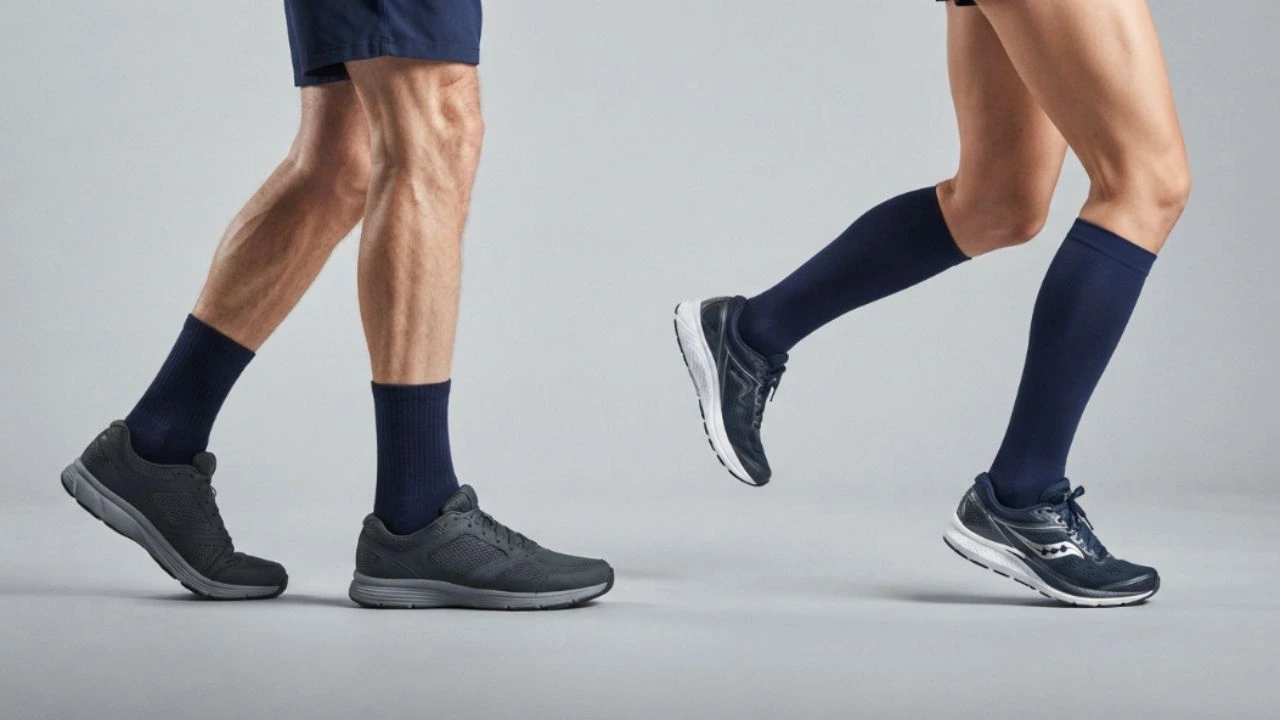
That airborne phase is why the numbers look so different once you dig into the research. Perry and Burnfield's gait analysis work shows that ground reaction forces during running climb dramatically higher than during walking, because every landing has to absorb the body's full weight after a moment of flight instead of a smooth, continuous roll from heel to toe. A study directly comparing the two at matched intensity found peak vertical ground reaction force during running measured 844 newtons, compared to roughly 570 to 580 newtons for brisk walking at a similar effort level, alongside a noticeably faster loading rate. In plain terms: running asks your joints to absorb more force, faster, with every single stride.
That doesn't automatically make running "worse" for your joints, though, and this is the part most beginner guides get backwards. A separate biomechanics study found that while peak knee joint loads were three times higher in running than walking, the per-distance load, the amount of stress your knee absorbs to cover the same mile, was no different between the two. Running's shorter ground contact time and longer stride actually offset some of that higher peak force over distance. This tracks with Owen Anderson's broader point about running economy: it's not raw force that determines injury risk, it's how efficiently your body absorbs and redistributes that force stride after stride.
On the cardiovascular side, the science is less dramatic than the internet makes it sound. A large comparison of runners and walkers found that when both groups expended the same amount of energy, meaning the walker simply walked further or longer to match a runner's effort, they saw nearly identical reductions in risk for high blood pressure, high cholesterol, and diabetes. The catch Rex didn't see coming: matching that energy expenditure by walking takes roughly 1.5 times longer than running the same distance, since running burns more energy per minute at a typical pace.
So the real difference between running and walking isn't "one is good and one is bad." It's a trade-off between impact tolerance and time efficiency, and knowing which side of that trade-off your body is ready for is exactly what the rest of this guide breaks down.
Running vs Walking Calories: The Numbers Rex Actually Needed
Rex's gym-bro was half right, but for the wrong reason. Calorie burn does differ between running and walking, but not because one "counts" and the other doesn't.
At matched distance, research consistently shows running burns more total energy than walking the same mile, with one controlled study measuring roughly 25% higher calorie expenditure for running a mile compared to walking it. WebMD's comparison puts real numbers on this: a 160-pound person walking briskly for 30 minutes burns around 156 calories, while running at a moderate pace for the same 30 minutes burns closer to 356 calories. The gap comes down to intensity per minute, not some hidden walking penalty.
But here's the twist that flips the whole debate: when you match for time instead of distance, and let the walker simply walk longer to cover more ground, the calorie gap nearly disappears. A large-scale comparison of over 33,000 runners and nearly 16,000 walkers found that when exercise was measured by time rather than distance, walking produced health benefits, including reduced diabetes, cholesterol, and blood pressure risk, that were statistically comparable to running. Running is simply the faster way to burn a given number of calories; walking gets you to the same physiological destination, it just takes longer to arrive.
When Beginners Should Choose Walking Over Running
This is the question most "just start running" content skips entirely, and it's exactly where Rex's shuffle-jog experiment went wrong.
Walking isn't the lesser option for every beginner. For anyone managing joint sensitivity or early osteoarthritis, walking is specifically recommended over running precisely because it avoids the repeated impact loading that can aggravate an already irritated joint, while still stimulating the joint's natural lubrication through gentle, continuous movement. If your knees, hips, or ankles complain during normal daily activity before you've even started training, walking is the biomechanically smarter entry point, not a consolation prize.
For everyone else, the honest answer is that running and walking aren't competing choices, they're sequential tools. This is exactly why AthliFly's beginner run-walk method exists: it lets you access running's faster calorie burn and cardiovascular stimulus while borrowing walking's lower impact force during the recovery windows between running bursts, so your joints get exposed to running's higher loading rate in small, manageable doses instead of all at once.
Not sure if your current joint tolerance is ready for running intervals, or if you should start with walking first? Take our 60-second Joint-Friendly Shoe Quiz to find out where your body actually stands.
Common Mistakes When Choosing Between Running and Walking
Treating walking as "not a real workout": at matched time investment, walking delivers cardiovascular benefits statistically similar to running, so dismissing it undervalues a legitimately effective tool.
Jumping straight to running without checking joint tolerance: skipping this step ignores that running's peak impact force is meaningfully higher than walking's, even though the total load per mile evens out over distancepubmed.
Assuming walking takes the same time investment as running: matching running's calorie burn through walking alone requires roughly 50% more time on your feet, which matters if your schedule is tight.
Ignoring existing joint pain before choosing running: pushing into running with pre-existing joint irritation contradicts the specific guidance that walking is the safer choice when osteoarthritis or joint sensitivity is already present.
Frequently Asked Questions
Is running or walking better for weight loss?
Running burns more calories per minute, but walking can match that total burn if you walk longer, since research shows equivalent health benefits when both are matched for total time invested rather than distance.
Does running hurt your knees more than walking?
Running does produce a higher peak impact force per stride than walking, but studies show the total joint load per mile traveled is roughly similar between the two, since running's shorter contact time offsets its higher peak force.
Should a complete beginner start with walking or running?
Beginners with healthy joints and no pain can start directly with a run-walk approach, while anyone with existing joint sensitivity or osteoarthritis should lean toward walking first, since it avoids the repeated impact that can aggravate an irritated joint.
Can walking alone get you fit, or do you need to run eventually?
Walking alone can meaningfully improve cardiovascular health, but reaching running-level fitness gains in less time requires eventually incorporating some running, since running achieves the same calorie burn and conditioning stimulus in roughly a third less time.pubmed.
Why does running feel so much harder than walking even at a slow pace?
Running requires an airborne phase between strides that walking never has, which recruits more muscle force and drives up oxygen consumption immediately, making even a slow jog feel more demanding than a brisk walk.