
Why Starting to Run Feels So Hard: Rex's Reality Check
Running for beginners sounded simple enough on paper: put one foot in front of the other, repeat, done.
So I laced up an old pair of gym sneakers, stepped outside, and made it four minutes before my lungs staged a full walkout and my shins started sending strongly worded complaints.
I stood there, hands on knees, wondering how every "beginner" running video makes it look like a light jog through a golden-hour park — and why nobody mentioned that starting from zero feels less like exercise and more like a hostage negotiation with your own body.
Turns out I'm not special. Most people who try to get into running quit in the first few weeks, not from laziness, but because nobody explained the actual starting conditions of a beginner's body — the joints, the breathing, the pace — before throwing them at a training plan built for someone else's fitness level.
I didn't need motivation. I needed someone to tell me what my first four weeks were actually supposed to look like, and why the burning in my shins wasn't a personal failure — it was a predictable, well-documented beginner problem.
Not sure if your old sneakers are making the impact worse? Take our 60-second Joint-Friendly Shoe Quiz before you read another step further.
The Biomechanics of Beginner Running: Why It Feels Brutal
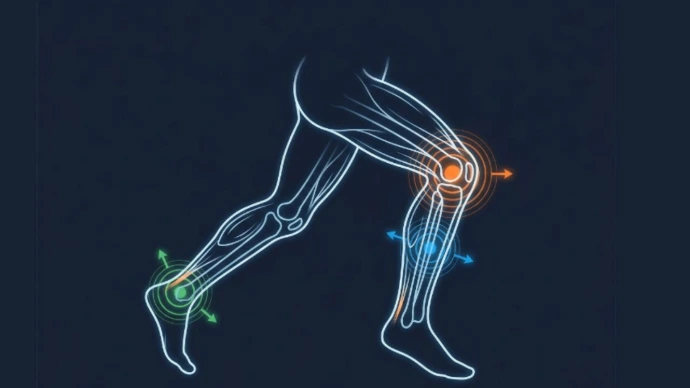
Here's the part Rex's Instagram feed left out: running is not walking, but faster. It's a series of small, controlled jumps, and every one of those jumps ends with your entire bodyweight crashing back into a single leg.
Perry and Burnfield's gait research describes this landing moment as the point where ground reaction force peaks hardest — their data shows vertical forces during running reaching nearly two-and-a-half times bodyweight, compared to a much gentler load during walking. That peak hits exactly during the phase where an untrained body has the least control. If your hips wobble, your stride is inconsistent, or your foot slaps down instead of landing softly, that force doesn't just disappear — it travels straight up into your shins, knees, and hips.
Owen Anderson makes a related point that most beginner guides skip entirely: running economy — how efficiently your body uses oxygen and energy per stride — is something built through form refinement over weeks, not something you're born with or without. Anderson's work on running form specifically highlights foot-strike pattern, stance time, and cadence as the fixable levers that separate an exhausting stride from an efficient one. Rex wasn't unfit in some permanent sense. His body simply hadn't yet learned the specific, repeatable motor pattern that makes running feel automatic instead of exhausting.
This is the gap between "just start running" content and what actually works: beginners aren't failing at willpower. They're being handed adult-level training loads before their tissues, cardiovascular system, and coordination have had time to adapt.
The Run-Walk Method: Why Walking Breaks Make You a Better Runner
Rex's biggest mistake wasn't fitness — it was pride. He treated every walk break like a white flag, something to avoid at all costs because "real runners don't walk."
That belief nearly ended his running career in week one. The truth is almost insulting in its simplicity: alternating between running and walking is not a beginner crutch, it's the actual mechanism that lets an untrained body build endurance without breaking down first. Jeff Galloway developed this run-walk-run approach back in 1974 specifically to keep new runners injury-free, and decades of coaching results back up his claim that planned walk breaks can nearly eliminate overuse injuries in beginners.ajc+1
The walk segments aren't downtime. They're recovery windows that let your heart rate drop just enough to keep the next running interval controlled instead of desperate, which is exactly what keeps your form from collapsing into the sloppy, high-impact stride that causes most beginner injuries.runnersworld+1
Not sure your stride is the problem and not just your fitness? Take our 60-second Joint-Friendly Shoe Quiz — sometimes the "fitness issue" is actually a footwear issue.
How Long Should a Beginner Run and Walk: The First Four Weeks
Most beginner content gives vague advice like "start slow" without ever defining what slow actually means in minutes and days. AthliFly's answer is specific, because ambiguity is exactly what gets people hurt or discouraged in week two.
The structure that works for real beginners follows Galloway's original gradual-insertion model: start with very short running bursts inside a mostly-walking session, and only increase the running portion once the current week feels genuinely easy.
This mirrors the same conservative, gradual-load logic found across evidence-based beginner guides: build time on feet before chasing speed or distance, and treat rest days as part of training, not a break from it.therunningweek+1
The evidence on single-session jumps is now sharper than the old blanket "10% weekly rule." A large cohort study of over 5,200 runners found that increasing any single run by more than 10% compared to your longest run in the past month raised overuse injury risk by 64%, and jumps over 100% raised it by 128%. In practice, that means the danger isn't just weekly totals — it's any one session that suddenly asks more of your body than it's used to.marathonhandbook+1
Normal Soreness vs a Warning Sign: When to Actually Stop Running
This is the question Rex actually needed answered in week one, and almost no beginner guide answers it directly.
Normal beginner soreness looks like this:
General muscle fatigue in the calves, quads, or glutes that shows up a day after running and fades within 48–72 hours
Mild breathlessness during running intervals that resolves quickly during walk breaks
A dull, generalized tiredness in the legs, not a sharp pain localized to one specific spot
Warning signs that mean stop, not push through:
Sharp, localized pain in the shin, knee, or arch that gets worse during the run instead of warming up and easing off
Pain that persists or worsens the next day instead of fading
Any pain that changes your gait, such as limping, favoring one leg, or altering your stride to compensate
Repetitive impact on hard surfaces is one of the leading contributors to running injuries, including stress fractures, which is exactly why walk breaks matter early on: they give tissues a chance to recover before the next load cycle begins.ajc
How to Warm Up and Cool Down Before a Beginner Run
Rex used to treat warm-ups the way most beginners do: he skipped them, laced up, and sprinted straight into his first running interval like the driveway was a starting gun.
That habit is one of the fastest ways to turn a manageable run-walk session into a pulled calf or a cranky Achilles. A proper warm-up doesn't need to be complicated. Five to eight minutes of brisk walking followed by dynamic movements like leg swings, walking lunges, and ankle circles is enough to raise tissue temperature and prep the joints for the impact forces that come with running.
Cool-downs matter just as much, even though they're the first thing beginners cut when they're short on time. A few minutes of walking to bring the heart rate down gradually, followed by light static stretching for the calves, hamstrings, and hip flexors, helps the body transition out of the loaded, repetitive motion pattern it just spent 20 to 30 minutes reinforcing.
Common Beginner Running Mistakes That Cause Injuries
Most beginner injuries aren't caused by running itself, they're caused by a small set of repeatable mistakes that show up across almost every new runner's first month.
Running too fast, too soon: beginners consistently underestimate how slow "easy pace" should actually feel, turning every run interval into an anaerobic sprint instead of a conversational jog
Skipping walk breaks out of pride: treating walk intervals as optional rather than structural undoes the entire purpose of the run-walk method
Increasing volume too quickly: a single run that's more than 10% longer than your recent longest effort is strongly linked to a spike in overuse injury risk.
Wearing the wrong or worn-out shoes: old casual sneakers or shoes with collapsed cushioning fail to manage impact force, which directly increases loading on the shins and knees
Ignoring localized pain: pushing through sharp, worsening pain instead of stopping is the single most common reason beginners end up sidelined for weeks instead of days
Still running in the same shoes you wear to the grocery store? Take our 60-second Joint-Friendly Shoe Quiz to see if your footwear is quietly working against your training plan.
How to Know You're Ready to Run a Continuous 5K
The jump from run-walk intervals to a continuous 5K isn't about hitting a calendar date, it's about hitting specific readiness markers in your body.
You're generally ready to attempt continuous running when your longest run interval feels fully conversational, when walk breaks start feeling like a choice rather than a necessity, and when you've completed at least one full week without any sharp or worsening pain during or after runs. Runners who gradually progress their run intervals following a structured model like Galloway's typically report an almost negligible injury rate specifically because they let the body dictate the pace of progression rather than the calendar.
If you're not there yet, repeating a week is not a setback. It's the same conservative, gradual-load principle that runs through this entire guide: better to repeat a week than to force a jump your tissues aren't ready for.
Frequently Asked Questions
How long does it take a beginner to run a 5K?
Most structured beginner programs move from zero running experience to a continuous 5K in 8 to 10 weeks, following gradual increases in run interval length rather than jumping straight into distance.
Do I need special running shoes to start running as a beginner?
Yes, beginner-specific footwear helps manage impact forces during the highest-risk adaptation period, since worn-out or non-running shoes fail to attenuate the loading rates that cause shin and knee pain.
Can I lose weight just by following a beginner running plan?
Running plans support weight management as part of overall activity level, but the run-walk method is primarily designed to build sustainable fitness and reduce injury risk, not as a standalone weight-loss protocol.
What if I can't complete a full running interval in Week 1?
Repeating Week 1 or reducing interval length is a normal, expected adjustment. It reflects individual differences in starting fitness, not failure to follow the plan correctly.
Is it normal to feel like running never gets easier?
Running economy, the efficiency of your movement, improves measurably as your form and cadence refine over consistent weeks of training, so the effort of a given pace should genuinely decrease as your body adapts.